VISUAL APPLICATION ENGINEERING

Application
Drawings

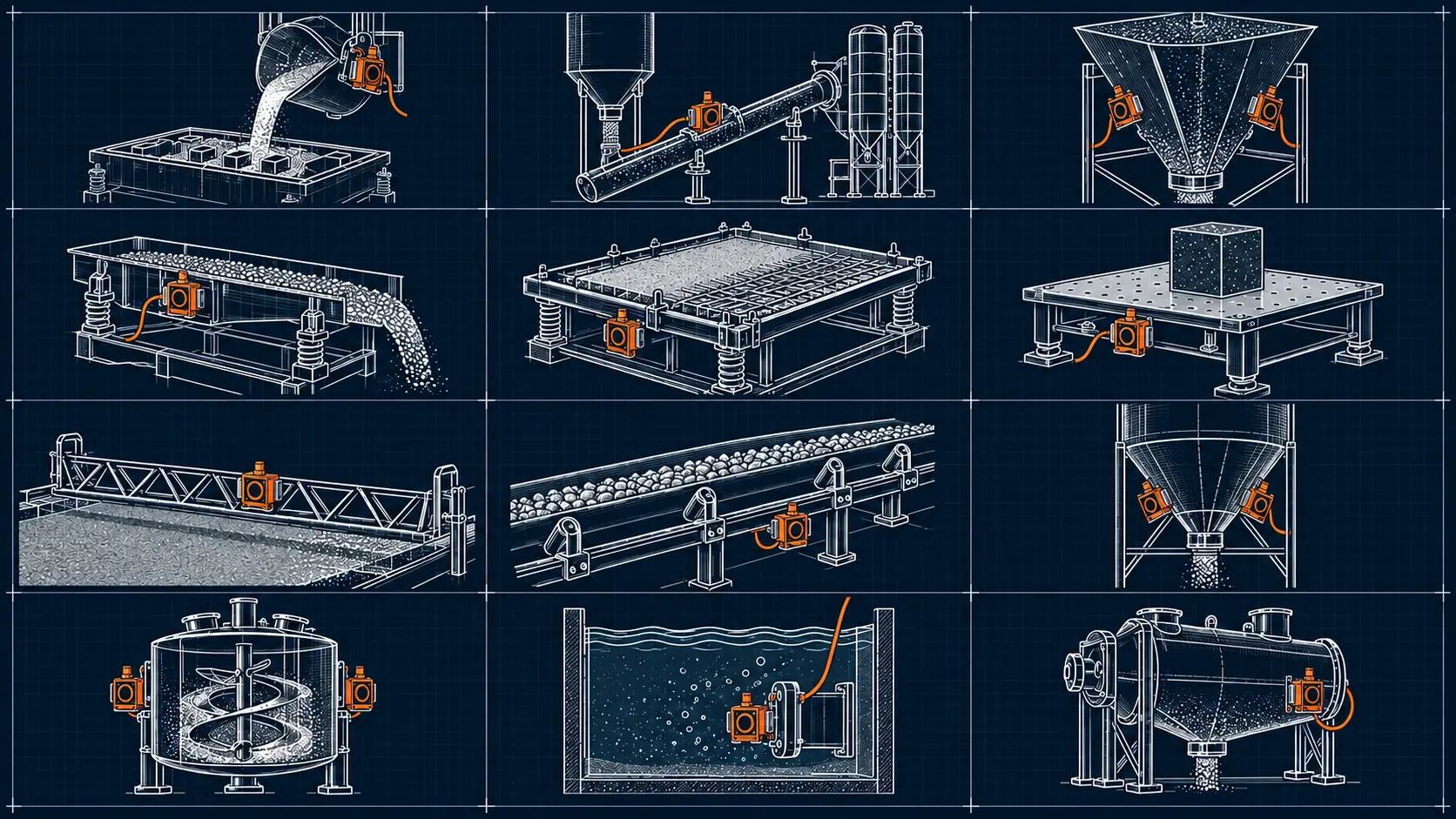
Every industrial process transfers resonance differently. These twelve concepts show where the RESONATOR system acts, how that excitation supports the equipment and what engineers should validate before implementation.

Application concept · technical illustration
InputHigh frequency
MotionLow amplitude
ResponseLoad-adaptive
MethodProcess-validated
12 PROCESS ENVIRONMENTS

Select the closest process.

The illustrations show application principles rather than final installation drawings. Mounting position, model, pneumatic supply and operating window are confirmed against the real structure, material and process objective.

01 / MOULD PROCESSRVS™

Foundry moulds

RVS transfers high-frequency excitation through the mould or supporting frame while material is placed. The objective is more consistent filling around complex geometry, reduced trapped voids and controlled settling without large-amplitude movement.

Supports
Filling · settling · air release
Validate
Mould stiffness, material response and cycle time
Platforms & rigsExplore custom industrial engineering
02 / ENCLOSED TRANSFERRVS™

Pipe feeding

Excitation enters the feeder or pipe wall close to the resistance point. It can support continuous movement of powders or granular material, reduce adhesion and help stabilize transfer through enclosed conveying equipment.

Supports
Material movement · reduced wall adhesion
Validate
Pipe geometry, inclination and target flow rate
Explore conveyors and feeders
03 / BULK STORAGERVS™

Hopper flow

RVS units transfer resonance into the hopper walls and cone where bridging or rat-holing begins. Properly positioned excitation helps mobilize stagnant material and supports more reliable discharge toward the outlet.

Supports
De-bridging · discharge · flow consistency
Validate
Material cohesion, wall angle and outlet geometry
Explore silos and hoppers
04 / DOSINGRVS™

Controlled feeding

Mounted to the feeder structure, RVS provides compact excitation that can help material advance without heavy shaking. The system is configured to support a stable feed condition while limiting unwanted impact on surrounding equipment.

Supports
Dosing stability · controlled movement
Validate
Feed accuracy, structure response and segregation risk
Explore feeder applications
05 / CONSOLIDATIONRVS™

Precast compaction

Resonance is introduced through the mould or table frame and distributed into fresh concrete. The engineering objective is improved consolidation, trapped-air release and more consistent mould filling with low-amplitude excitation.

Supports
Compaction · deaeration · surface consistency
Validate
Mix design, mould geometry and reinforcement density
Explore precast and concrete
06 / TESTINGRVS™

Vibration testing

RVS excites the test platform directly, creating a repeatable structural response for product settling, process trials or equipment evaluation. Frequency, fixture and load must be treated as one controlled test system.

Supports
Repeatable excitation · response testing
Validate
Payload, fixture stiffness and test acceptance criteria
Explore vibration tables
07 / SURFACE PROCESSRVS™

Screeding

Mounted to the screed or supporting beam, RVS introduces excitation along the working edge. It can support material settlement, levelling and air release while the tool advances across the surface.

Supports
Levelling · settlement · surface formation
Validate
Beam span, travel speed and material consistency
Explore concrete processes
08 / MATERIAL TRANSFERRVS™

Conveying

RVS couples to the conveyor frame near the area where material slows or accumulates. The excitation supports forward movement and cleaner transfer while the low-amplitude response helps limit uncontrolled structural motion.

Supports
Transfer · reduced accumulation · flow continuity
Validate
Frame dynamics, material load and transfer-point geometry
Explore conveyor applications
09 / DISCHARGERVS™

Silo discharge

RVS units act through the silo cone close to the outlet, where cohesive material commonly forms stable arches or adheres to the wall. Resonance supports material release and faster recovery from restricted flow.

Supports
Discharge · de-bridging · wall release
Validate
Silo construction, stored material and blockage pattern
Explore SiloFlow applications
10 / PARTICLE RESPONSERVS™ / RVC™

Resonance vibration activation

Excitation is transferred through the vessel wall while the primary process provides bulk circulation. Relative particle motion and collisions may support mobility or deagglomeration; the actual response is measured for each material.

Supports
Particle motion · wall release · deagglomeration trials
Validate
Flow, size distribution, compaction and segregation risk
Explore activation + the science
11 / WET PROCESSRVI™ Resonance Vibrator Immersion

Submerged systems

The immersion unit introduces vibration directly inside the liquid or wet process medium, shortening the energy path. It can support mixing, release trapped gas and mobilize material where external wall excitation is inefficient.

Supports
Direct excitation · mixing · deaeration
Validate
Liquid properties, immersion depth and material compatibility
Explore wet and immersion systems
12 / SPECIAL EQUIPMENTRVS™ / RVC™

Custom vessels

RVS couples to the vessel wall or supporting structure at an engineered force-transfer point. The configuration can support discharge, mixing, wall cleaning or process activation where standard mounting arrangements do not fit.

Supports
Process-specific movement · wall release
Validate
Vessel modes, mounting access and operating objective
Platforms & rigsExplore custom RESONATOR systems

These drawings communicate application principles. They are not installation instructions, force recommendations or universal performance claims. Final equipment selection and mounting require RESONATOR engineering review.

FROM DRAWING TO PROCESS

Validate the energy-transfer point.

Send your equipment drawing, material, current problem and desired result. RESONATOR will define the most relevant starting configuration for an engineering assessment or Industrial Pilot.